
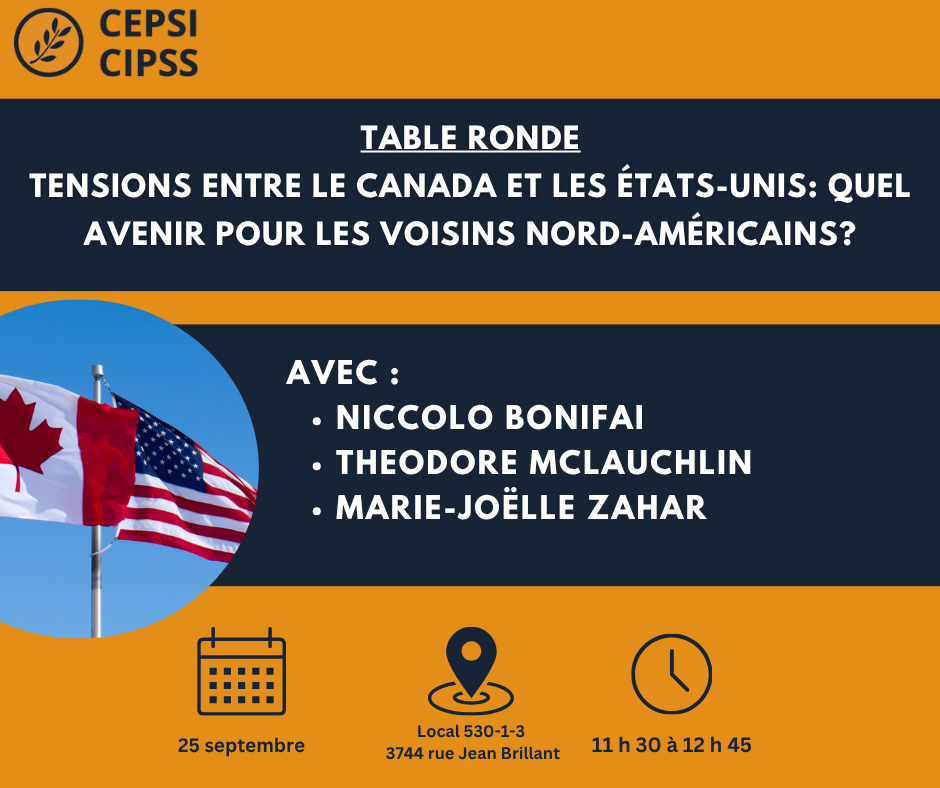
Tensions entre le Canada et les États-Unis: quel avenir pour les voisins nord-américains?
Afin de lancer la programmation de l'automne 2026, le CEPSI vous invite à une table ronde le 25 septembre sur les tensions actuelles entre les États-Unis et le Canada.
Seront présents autour de la table les professeurs Niccolò Bonifai, Marie-Joëlle Zahar et Théodore McLauchlin.
Quand : 25 septembre, de 11 h 30 à 12 h 45
Où : Local 530-1-3, 3744 rue Jean-Brillant
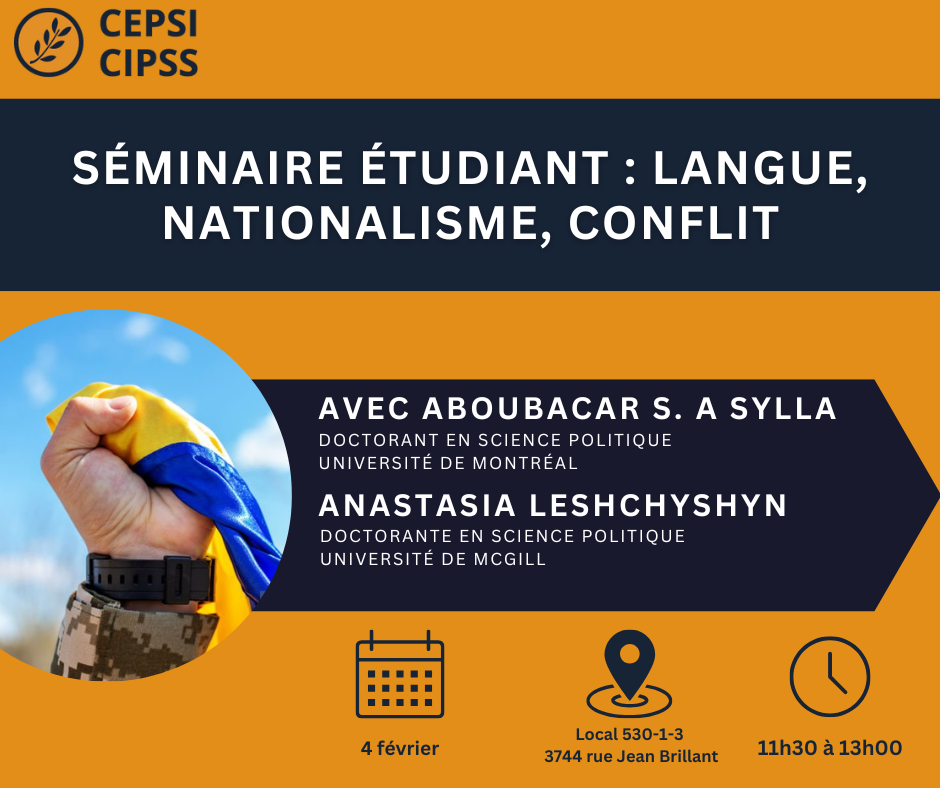
Séminaire étudiant : Langue, nationalisme et conflits
Ce séminaire réunira Aboubacar S. A Sylla (Université de Montréal) et Anastasia Leshchyshyn (Université McGill), qui présenteront leurs travaux et échangeront autour des liens entre pratiques linguistiques, nationalisme et dynamiques de conflit.
Quand : 4 février 2026, 11h30 à 13h00
Où : Local 530-1-3, 3744 rue Jean Brillant
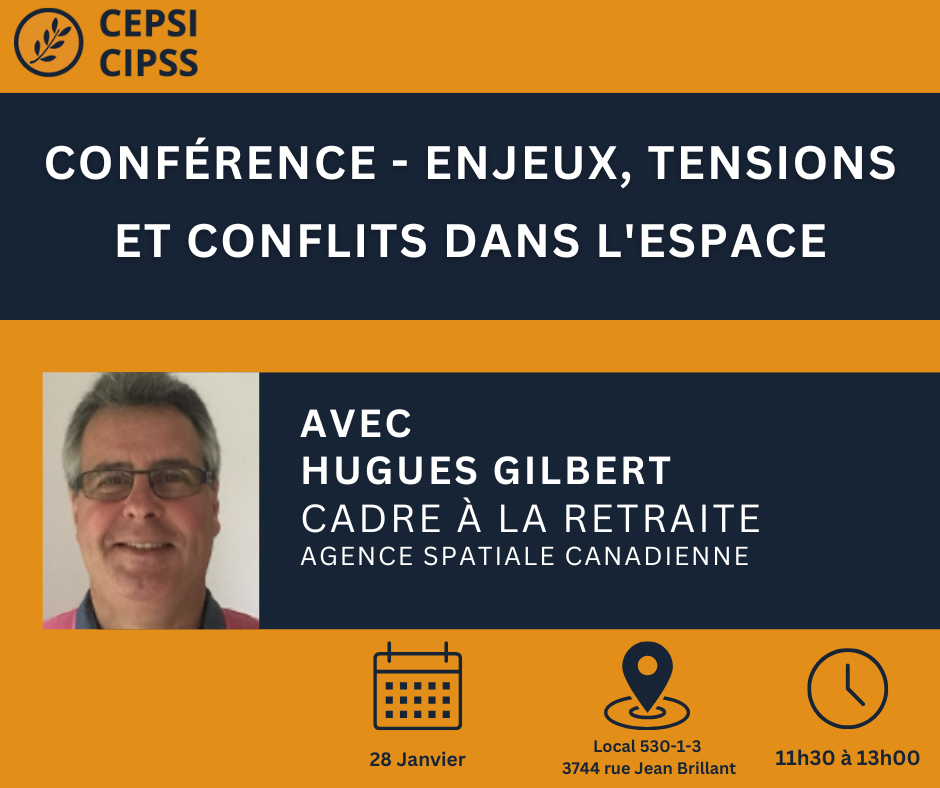
Conférence - Enjeux, tensions et conflits dans l'espace
Hugues Gilbert, cadre à la retraite de l’Agence spatiale du Canada, donnera une conférence sur l’importance stratégique de l’espace ainsi que les principaux enjeux qui découlent de son utilisation accrue.
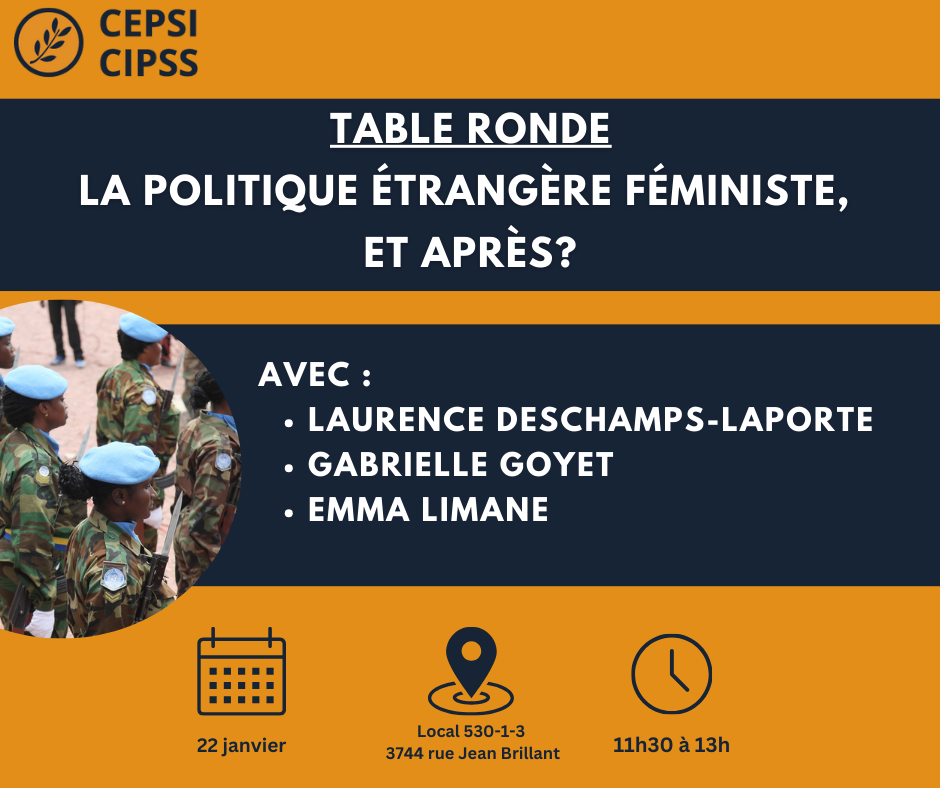
Table ronde de la rentrée 2026: La politique étrangère féministe, et après?
Afin de lancer la programmation de l’hiver 2026, le CEPSI vous invite à une table ronde le 22 janvier sur les évolutions et les limites de la politique étrangère féministe.
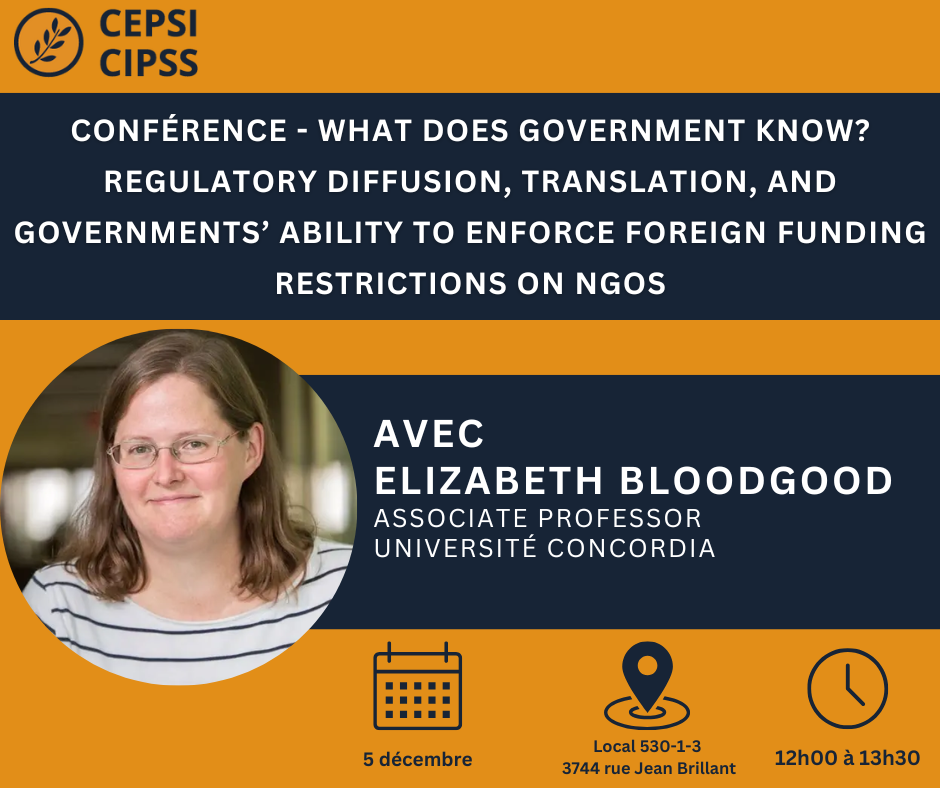
Conférence - Conférence - What Does Government Know? Regulatory Diffusion, Translation, and Governments’ Ability to Enforce Foreign Funding Restrictions on NGOs
Elizabeth Bloodgood, professeure associée à l'Université de Concordia, donnera une conférence portant sur les restrictions financières imposées aux ONG par les États.
Quand : 5 décembre 2025, 12h00 à 13h30
Où : Local 530-1-3, 3744 rue Jean Brillant
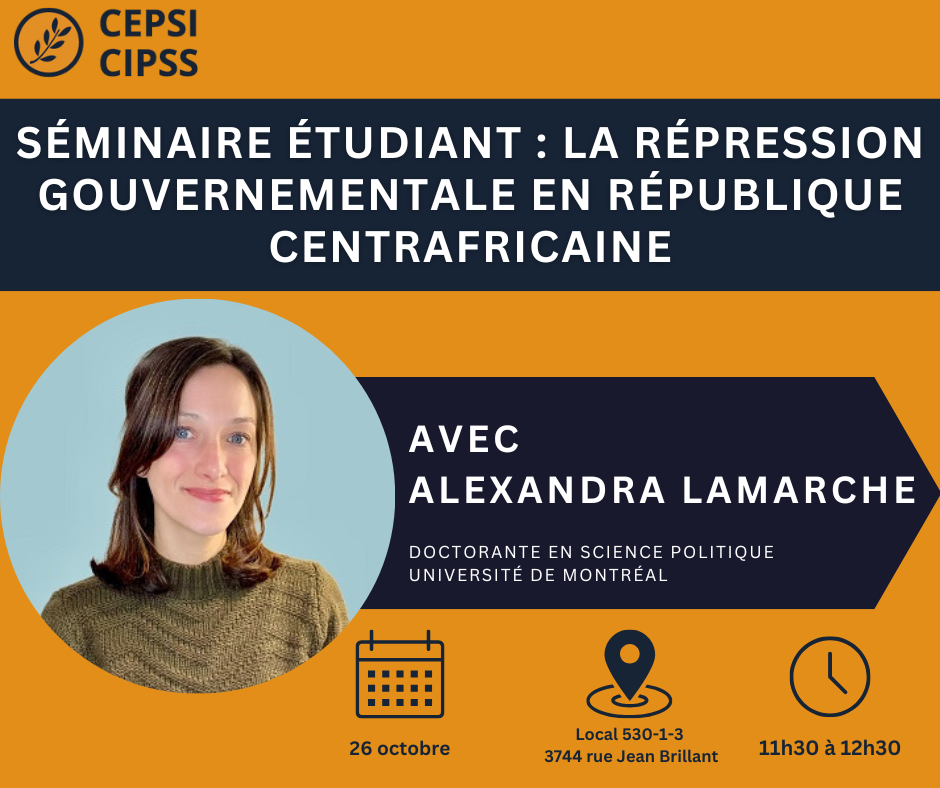
Séminaire étudiant : La répression gouvernementale en République centrafricaine
Le 26 novembre, Alexandra Lamarche, doctorante en science politique à l'Université de Montréal, présentera sa recherche portant sur la répression gouvernementale en République centrafricaine.
Quand : 26 novembre 2025, 11h30
Où : Local 530-1-3, 3744 rue Jean Brillant
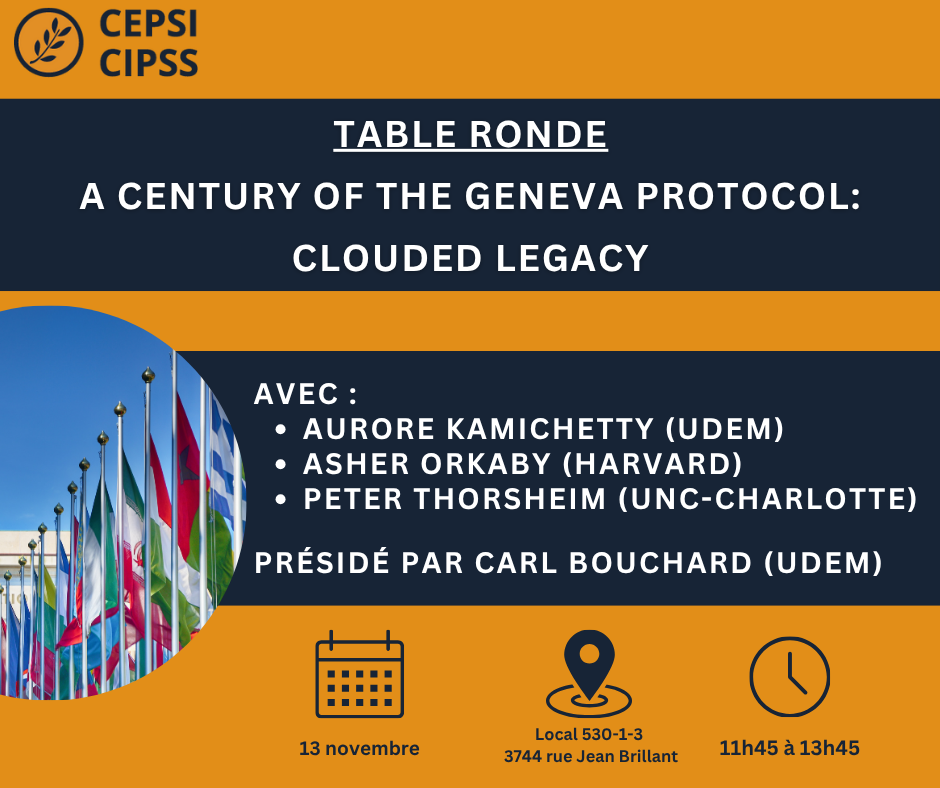
Table ronde - Century of the Geneva Protocol : Clouded Legacy
À l'occasion du centenaire du Protocole de Genève de 1925 interdisant l'emploi à la guerre de gaz asphyxiants, toxiques ou similaires et de moyens bactériologiques, cette table ronde revient sur l'héritage et la portée historique de l'année 1925 en s'appuyant sur des cas d'étude ancrés dans différentes périodes historiques.
Avec :
Dr. Asher Orkaby, professeur d'histoire à Harvard University
Dr. Peter Thorsheim, professeur d'histoire à University of North Carolina at Charlotte
Aurore Kamichetty, doctorante en histoire, Université de Montréal
Quand : 13 novembre 2025, 11h45
Où : Local 530-1-3, 3744 rue Jean Brillant

Conférence - Populism and Political Trust : Evidence from Latin America
We investigate populism’s effects in countries experiencing severe economic inequality. We posit that left populist parties use strong redistributive poli- cies (which tackle the roots of political dissatisfaction) and anti-elite rhetoric (which increases credibility in electoral pledges) to build electoral support. In turn, this policy and rhetorical innovation raises political trust among left populist voters, especially with their party in power.
We test our argument in Latin America, using a repeated cross-section individual-level dataset (1995– 2020) and two original survey experiments. We find strong evidence that left populist parties increase social spending, reduce inequality, and elevate political trust among their voters. This positive effect on trust is driven by both electoral pledges to implement generous redistributive policies and these policies’ actual economic outcomes. The trust increase proves long-term and driven by policy position rather than partisanship. Trust does not increase among voters of other party families, including right populist parties.
Keywords: Inequality, populism, political trust, redistribution.
Quand : 5 novembre 2025, 11h30-12h30
Où : Local 530-1-3, 3744 rue Jean Brillant

Conférence - Wartime Origins of Social Policy: How Contraband Camps Shaped Redistributive Programs in the U.S. South
The hallmark of the modern nation-state is its redistributive and social welfare programs. Yet, these programs vary considerably both nationally and subnationally. Why? Focusing on the U.S. South after the Civil War, a region with notoriously limited redistributive social programs, we argue that the wartime policy of contraband camps explains important variation in social welfare policies. Contraband camps involved investments in physical institutions, civilian leadership in camp administration, and high levels of exposure to redistributive and abolitionist ideas within camp communities. These three processes were highly concentrated in contraband camp counties and made post-war investments in redistributive social policy more likely. We test our arguments using new data, including full-count censuses. Results strongly support expectations: counties with a contraband camp had about a 74% increase in tax revenue compared to counties without one. Our results contribute to research on U.S. political development, redistributive social policies, war, and post-conflict reconstruction.
Quand : 15 octobre 2025, 11h30
Où : Local 530-1-3, 3744 rue Jean Brillant

Séminaire étudiant : La politique partisane et la base des investisseurs de la dette du gouvernement: résultats préliminaires
Le 8 octobre, Zhixiang Wang , doctorant en science politique à l'Université de Montréal, présentera sa recherche portant sur la politique partisane et de la dette du gouvernement.
Quand : 8 octobre 2025, 11h30
Où : Local 530-1-3, 3744 rue Jean Brillant

Séminaire étudiant - Les stratégies de diplomatie culturelle de la Russie
Séminaire étudiant - Les stratégies de diplomatie culturelle de la Russie

Hackathon :Expliquer des prédictions dela violence politique avec des outils IA
Vous vous intéressez à l’intelligence artificielle et aux dynamiques de la violence politique ? Cet événement est pour vous !
Au programme :
🔹 Formation pratique : découvrez les méthodes d’évaluation des grands modèles linguistiques, leurs forces, leurs limites et leurs usages en recherche.
🔹 Défi collaboratif : vous travaillerez à raffiner des prompts pour un GML afin d’expliquer et d’interpréter des prédictions de violence politique. L’objectif ? Explorer comment l’IA peut enrichir notre compréhension des conflits et des risques.

Conférence - Les enjeux liés à la défense de l’Arctique avec le Brigadier général Dan Rivière
Le brigadier général Dan Rivière, commandant de la Force opérationnelle interarmées Nord sera de passage au CEPSI le 17 septembre afin de donner une conférence portant sur les enjeux liés à la défense de l'Arctique.
Ne manquez pas cette occasion d'entendre le responsable de la protection du Nord sur ce sujet d'actualité !
Inscription obligatoire
Quand : 17 septembre à 15h00
Où : Local 6420, 3744 rue Jean Brillant

Table ronde de la rentrée 2025
Afin de lancer la programmation de l’automne 2025, le CEPSI vous invite à une table ronde le 9 septembre sur les enjeux internationaux qui passionnent les professeurs membres du CEPSI.